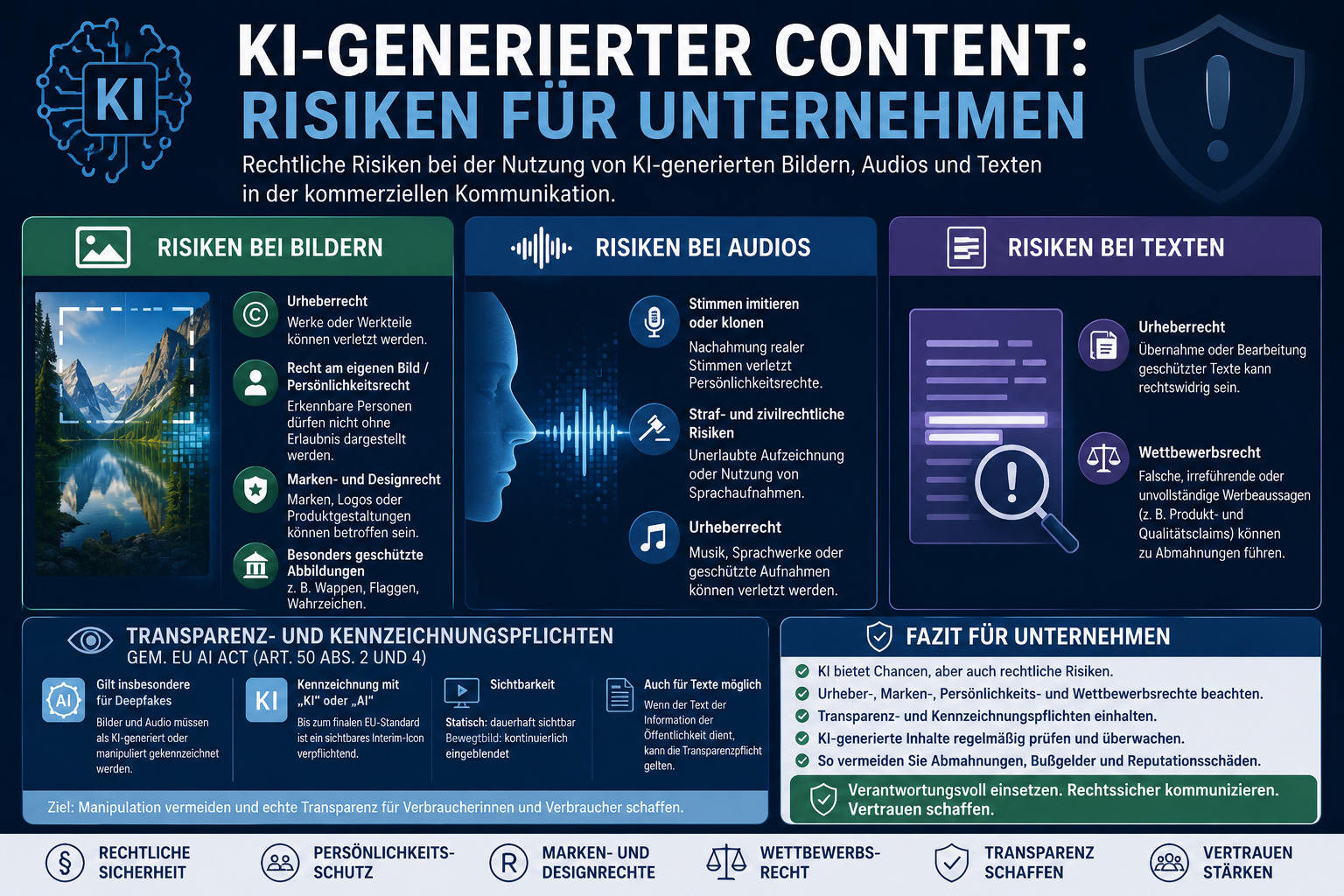
Companies are increasingly using AI-generated images, audio and texts in advertising and corporate communications. Depending on the type of content, different legal risks are involved.
Risks of AI images
For image content, the main risks lie in
- copyright, if existing works or parts of works are reproduced or adapted in a recognisably similar way,
- the right to one’s own image and the general right of personality, if real persons are recognisably depicted,
- trade mark and design law, if trade marks, logos or product designs are generated as well, and
- the reproduction of images specially protected by law (e.g. coats of arms, flags, landmarks of certain states).
Risks of AI audio
With audio content, there are considerable risks if voices are imitated or cloned. This affects in particular the general right of personality, possible criminal and civil consequences of unauthorised recording or use of real voice recordings, and copyright if musical works, literary works or protected recordings are reproduced in a recognisably similar way or adopted in substantial parts.
Risks of AI texts
With text content, the central risk lies in the unintentional adoption or adaptation of third-party protected texts, which may infringe copyright. In addition, there are competition law risks if incorrect, misleading or incomplete advertising claims (e.g. product and quality claims) are generated.
Labelling obligations for AI content
Since 2 August 2026, the transparency obligations under Art. 50 of the AI Act (EU) 2024/1689 have applied to all three types of content. Under Art. 50(2), providers of AI systems must ensure that generated or manipulated image, audio, video and text content is detectable as artificially generated in a machine-readable format; for systems placed on the market before 2 August 2026, under the Digital Omnibus (Regulation (EU) 2026/1744, in force since 27 July 2026) a transitional period until 2 December 2026 applies. Deployers that generate or manipulate so-called deepfakes must disclose this under Art. 50(4). On 10 June 2026, the European Commission published a voluntary code of practice for marking and visible labelling; it provides for multi-layered marking and a common EU symbol. A disclosure obligation may also exist for AI-generated texts if they are published to inform the public on matters of public interest; it lapses if the texts are subject to human editorial control and someone holds editorial responsibility.
German competition law may also effectively require labelling of AI-generated corporate communications in order to avoid misleading consumers. As unfair competition law is largely harmonised in the EU, we recommend continuously monitoring compliance with these standards in AI-supported advertising and regularly checking AI-generated content before publication.