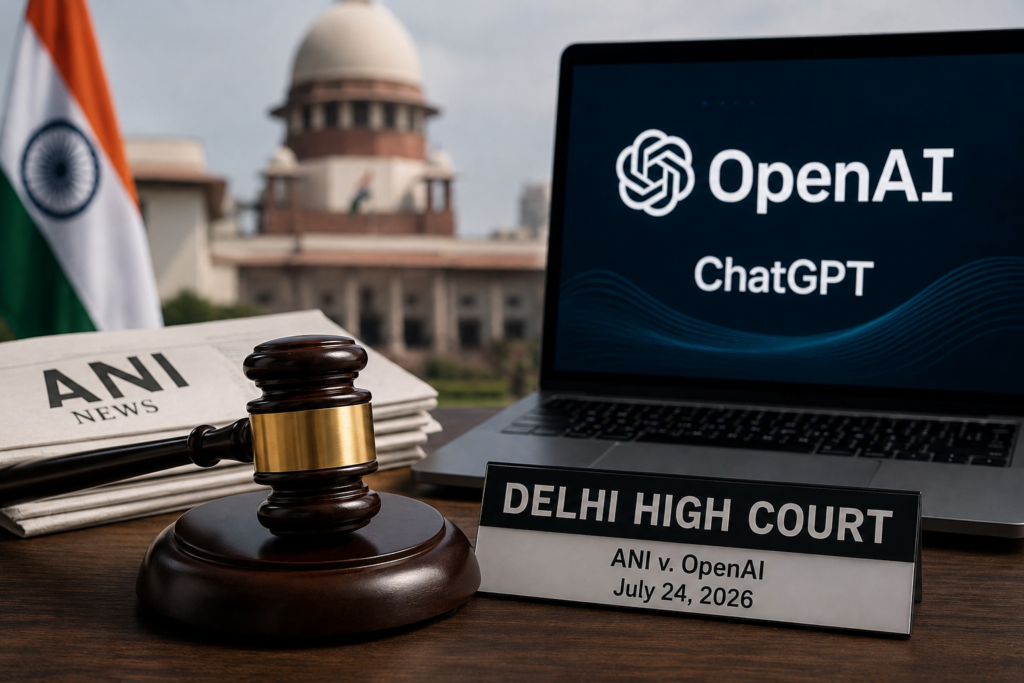
May an artificial intelligence be trained with copyright-protected news? This question is occupying courts worldwide. In widely noted proceedings between the Indian news agency ANI and OpenAI, the Delhi High Court has set an initial course.
The decision of the Delhi High Court is an important interim step in the worldwide dispute over the training of generative AI.
By decision of 24 July 2026 the court rejected ANI’s application for an interim injunction against OpenAI. In the summary proceedings, the judges saw insufficient evidence that ChatGPT impermissibly reproduces or memorises the news agency’s copyright-protected content. The main proceedings are still pending.
What was it about?
The Indian news agency Asian News International (ANI) accuses OpenAI of having used its copyright-protected news reports without a licence to train its language models.
In ANI’s view, merely storing and processing the articles for training the AI infringes copyright. The news agency also argued that ChatGPT could reproduce the content of its reports almost unchanged and in some cases even falsely attribute it to ANI.
OpenAI rejected these allegations and argued, among other things, that the training of large language models is to be classified as permissible fair dealing under Indian law.
No interim injunction against OpenAI
In the summary proceedings, the Delhi High Court largely followed this line of argument.
The court found that ANI had not currently made a prima facie case for immediate injunctive relief. In particular, there was insufficient evidence that ChatGPT actually stores protected news articles and subsequently reproduces them in a manner relevant under copyright law.
OpenAI was thus initially spared a court prohibition on training or operating ChatGPT. The dispute has not been finally decided: the main proceedings will show what requirements the court sets for proving impermissible storage and reproduction of training data.
The court develops a test for AI training
The Delhi High Court developed its own three-stage test for the question of whether the training of a large language model falls under the exceptions in Indian copyright law. The focus is on the following questions:
- Is the use exclusively for training the language model?
- Does it create economic competition with the original works?
- Are legitimate economic interests of the rights holders specifically impaired?
These criteria could in future also influence the international debate on AI training and copyright beyond India.
Why the alleged “memorisation” could not be proven
A central point of contention was the so-called Memorisation. Rights holders worldwide argue that language models can store parts of their training data and later reproduce them almost unchanged.
In the court’s view, ANI did not succeed in providing this proof in the proceedings against OpenAI. The examples submitted were not sufficient to make a prima facie case of substantial adoption of the protected news reports by ChatGPT. Nor could the court find that OpenAI systematically reproduces copyright-protected content.
Significance for international AI proceedings
Courts in the USA, Europe and Asia are currently dealing with similar questions:
- May copyright-protected material be used to train generative AI?
- When is there merely statistical learning?
- When is protected content actually stored?
- When does an AI output become a reproduction relevant under copyright law?
The decision of the Delhi High Court shows that courts are increasingly distinguishing between the actual training of an AI model and a subsequent infringing output.
What does this mean for companies?
For companies that develop or use generative AI, the decision initially creates a certain degree of legal certainty. The court makes clear that not every use of copyright-protected content in training automatically constitutes copyright infringement.
However, the legal risks have not been eliminated. If it can be proven in future that an AI model actually stores protected content and reproduces it almost identically, the assessment may be different.
Companies should therefore pay particular attention to the following points:
- lawful origin of the training data,
- technical measures against unwanted memorisation,
- documentation of training processes,
- compliance in the use of generative AI,
- contractual provisions with AI providers.
Contrast with German case law
Noteworthy is the timing in relation to the judgment of the Regional Court of Munich I in the proceedings GEMA v SUNO.
While the Munich court assumes that an AI music generator actually memorised and reproduced protected musical works, the Delhi High Court did not consider such proof to have been provided in the case of ChatGPT.
Both decisions show that in future, the technical properties of an AI model and the specific form of the content generated will above all determine the copyright assessment.