
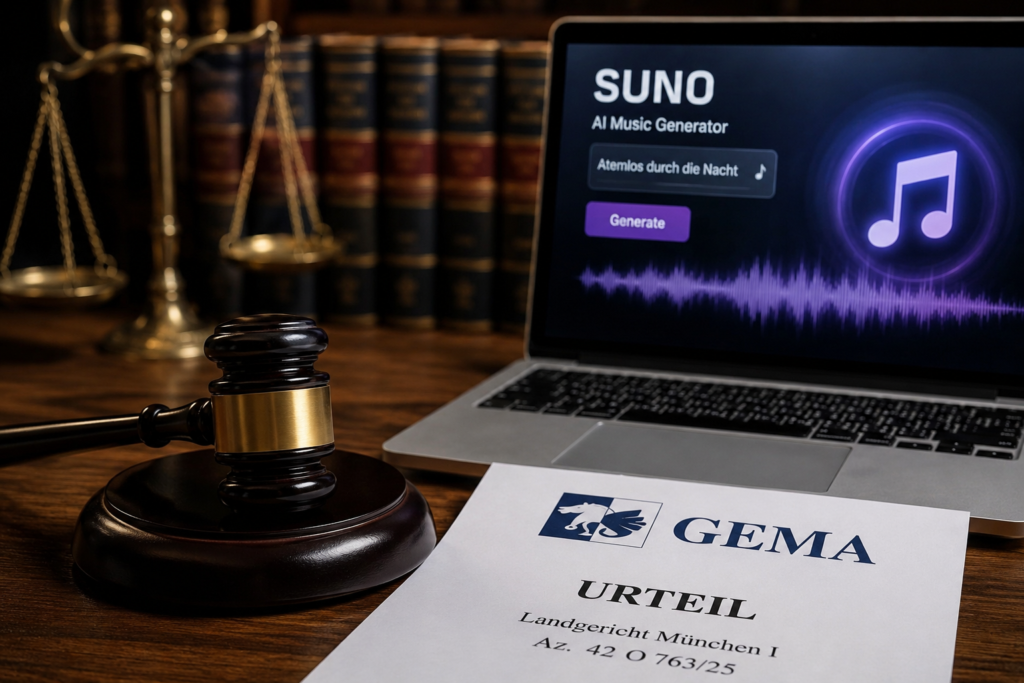
AI-generated music is once again the focus of the courts. In its judgment of 31 July 2026 (ref. 42 O 763/25), the Regional Court of Munich I largely found in favour of GEMA. The court ruled that the provider of the AI music generator SUNO is liable for copyright infringements. The focus is on both the training of the AI with protected musical works and the output of pieces of music that are substantially similar to the originals.
The decision is likely to be significant far beyond the music sector. It concerns fundamental questions of AI training, the so-called memorisation of training data and the responsibility of providers of generative AI systems.

As lawyers for AI law, we advise you comprehensively. Contact us for an initial consultation.
What was it about?
GEMA sued the operator of the AI music generator SUNO. The proceedings concerned well-known titles such as:
- “Atemlos durch die Nacht”
- “Rasputin”
- “Big in Japan”
- “Forever Young”
- “Mambo No. 5”
- “Daddy Cool”
The claimant argued that these musical works had been used to train the AI model without the necessary licence. In addition, the works had been stored (“memorised”) in the model and could be reproduced almost unchanged through simple user inputs.
It was noteworthy that the test inputs only contained the song title, the lyrics and the desired musical style. No specifications were given regarding melody, harmony or arrangement.
The court finds copyright infringement already in training
The Regional Court of Munich I found that the musical works had been reproduced in the course of training. In the chamber’s view, the works were subsequently contained in the AI models in reproducible form.
The judges relied on the concept, recognised in computer science, of Memorisation. This refers to the fact that an AI model does not merely learn abstract structures or statistical patterns but actually stores parts of the training data and can output them again later.
The court considered precisely this to be proven in the present case.
AI outputs can constitute copyright infringement
The assessment of the generated pieces of music is particularly far-reaching.
In the court’s view, the creative elements of the protected works were recognisable in the pieces of music output. This constituted not only an impermissible reproduction under Section 16 Copyright Act but also a communication to the public within the meaning of copyright law.
The court expressly emphasised that responsibility could not be shifted to the users. It relied on the following circumstances:
- The AI models were developed by the provider.
- The provider determined the architecture of the models.
- The provider selected the training data.
- The provider was responsible for the storage and memorisation of the works.
- The users merely used simple, open prompts.
The generated content was therefore attributable to the AI provider.
Text and data mining does not protect the provider
SUNO relied, among other things, on the exception for text and data mining (Section 44b Copyright Act). The Regional Court did not follow this argument.
The judges no longer regarded the permanent storage of the musical works in the AI model as a privileged analysis of the training data. As soon as protected content is present in the model in reproducible form and can be output again later, the limits of the copyright exceptions are exceeded.
The judgment thus sets clear limits for training generative AI with copyright-protected works.
The US fair use doctrine did not help SUNO either
Another focus of the proceedings was the training of the AI in the USA. SUNO argued that the training was covered by the fair use doctrine under US law. The court did not follow this argument either.
In the chamber’s view, the present case differs significantly from the US proceedings Bartz and Kadrey, in which US courts had partly assessed AI training as permissible fair use.
The difference is that there the training data were not output again, or only to a small extent, whereas in the SUNO proceedings content could be generated that was substantially similar to the original works. In the court’s view, it was precisely this reproducibility that argued against applying the fair use doctrine.
Why the judgment is important for the entire AI industry
The decision does not only concern music generators. It may have considerable effects on numerous areas of generative AI:
- AI image generators
- Language models
- Video AI
- AI systems for programming
- Multimodal AI systems
Comparable legal questions can arise whenever copyright-protected content is used for training and later reappears in the results.
The concept of Memorisationis of particular importance here. It is likely to be decisive in many future copyright proceedings against AI providers.
Significance for companies
Companies that develop or use generative AI should closely follow the further development of the proceedings.
In particular, a legal review is recommended with regard to:
- the origin of the training data,
- existing rights of use,
- technical measures against the reproduction of protected content,
- contractual provisions with AI providers,
- compliance processes in the use of generative AI.
Companies that use AI-generated content commercially should not rely on all outputs being free of third-party rights either.
The Regional Court of Munich I states with this degree of clarity that both training an AI model and the subsequent output of memorised content can constitute copyright infringement. This increases the pressure on developers of generative AI to license training data in a legally secure manner and to take technical measures against the reproduction of protected works.
The judgment is not yet final; it remains to be seen how the higher courts will decide.